
Flinders Island battles bushfire as blazing summer forecast
A Flinders Island bushfire has destroyed or damaged six structures, as the latest long-range weather outlook shows almost all of Australia faces a hotter than usual summer.
Tasmania Fire Service northern deputy regional chief Steve Richardson says emergency and watch and act warnings have been issued for the fire on the northern end of the island, with residents sheltering in place.
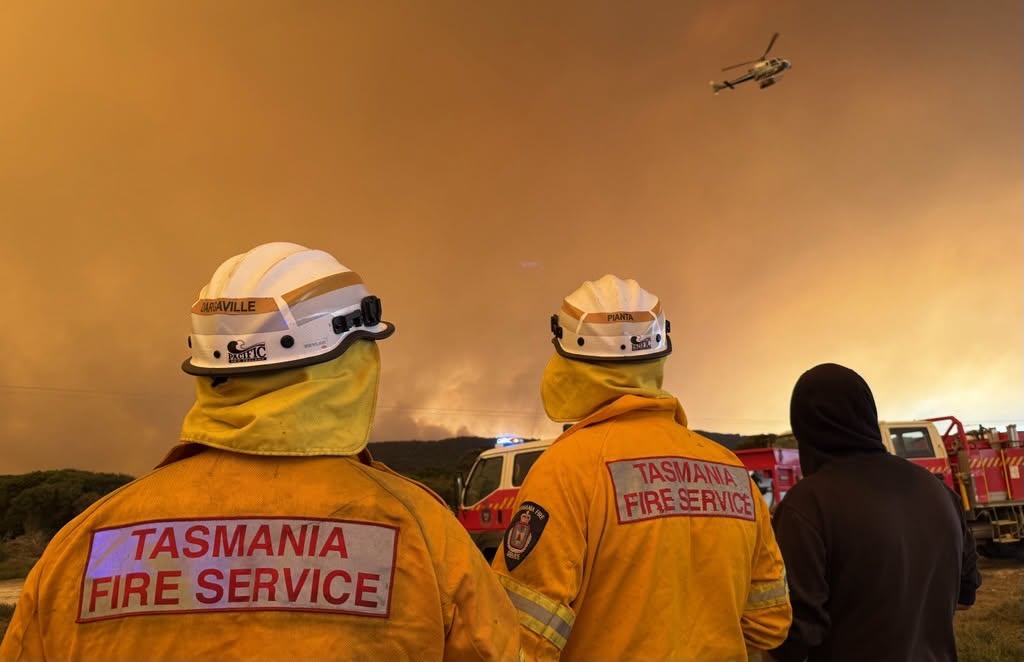 Firefighters at the scene. Credit: Tasmania Fire Service
The service reported 10m-high flames on the western edge of the fire, which covers about 14,300 hectares overall and has a perimeter of about 80km.
Six helicopters and three fixed-wing aircraft are supporting ground crews and volunteers from the fire service and Tasmania Parks and Wildlife Service.
Wind speeds eased today after dangerous weather conditions stopped crews getting near the fire.
“Unfortunately, at this stage, we believe six structures have been damaged or destroyed by the fire,” Mr Richardson said. “When we’re able to access the area safely, we’ll know more about these structures, and any other damage that may have been caused.”
The Bureau of Meteorology’s December-February outlook says maximum temperatures are very likely to be above average across almost all of Australia, with a 70% chance of unusually high maximums in eastern parts of NSW, eastern Tasmania, and much of WA and the north.
December-February rainfall is likely to be below average across most of northern WA and the NT, plus parts of the far southeast including much of Tasmania.
There is a 60%-70% chance of above-average rainfall for parts of southern Queensland and northeastern NSW along and west of the Divide.
The bureau says a strong to very strong El Nino remains active in the Pacific and a positive Indian Ocean Dipole is continuing.